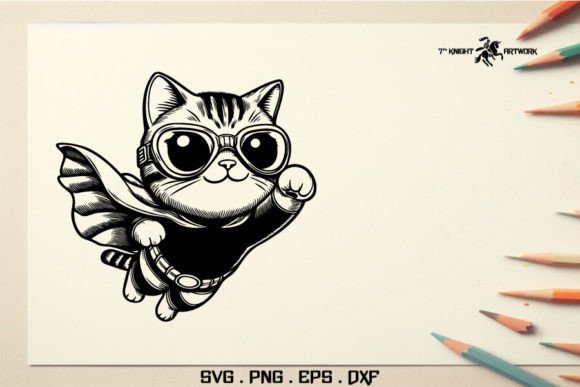
Super Cat SVG: A Designer’s Real-World Embroidery Review
As a designer who’s stitched hundreds of custom pieces—from boutique baby onesies to Etsy best-selling tote bags—I opened Super Cat Svg expecting charm, but what stood out immediately was its quiet versatility. This isn’t a cartoonish, over-the-top cat; it’s sleek, slightly stylized, with clean curves and expressive eyes that read clearly even at 3 inches wide. The shape feels intentional—not too busy, not too sparse—making it a natural fit for both subtle branding and playful handmade products.
First Impressions: Mood, Scale, and Embroiderability
The design carries a warm, approachable energy—friendly without being cutesy, modern without feeling cold. Its balanced proportions mean it won’t overwhelm a small hoop or vanish on a large sweatshirt front. I instantly pictured it centered on a linen tea towel, stitched in soft ecru thread, or scaled down as a delicate chest embroidery on a newborn onesie. That kind of flexibility is rare in a single machine embroidery design—and it speaks to thoughtful vector construction.
Real Project Test: Embroidering a Cotton Canvas Tote Bag
Last week, I used Super Cat Svg for a client’s small-batch tote line—natural cotton canvas, medium-weight, no stretch. I chose a satin stitch outline with light fill stitch inside the ears and tail for texture contrast. The result? Crisp edges, no puckering, and excellent stitch definition—even where the curve of the ear meets the head. Customers responded strongly to how “handmade but polished” it looked—not stiff, not sloppy. That balance is everything when you’re selling a handmade product at craft fairs or online.
That said, I did pause before stitching it on a ribbed knit baby cap. Why? Because the fine inner details—like the slight taper of the whiskers and the subtle contour of the cheek—rely on stable fabric and precise tension. On highly textured or stretchy surfaces, those elements can blur. If you’re planning baby embroidery or sweatshirt embroidery, test first on scrap with your exact stabilizer stack. A lightweight cutaway works better than tear-away here.
Where It Shines (and Where to Proceed Thoughtfully)
Super Cat Svg excels in applications where clarity and charm matter more than intricate realism:
- Tote bag design — centered or corner-placed, it reads beautifully from a distance
- Aprons and pillow covers — its confident silhouette holds up well against busy prints or solid-color backgrounds
- Personalized gifts — pairs effortlessly with monograms or simple date embroidery
- Holiday embroidery — add a tiny red bow or green collar in thread for seasonal flair
- Commercial embroidery — clean lines mean faster digitizing adjustments if you need to adapt it for multi-color runs
Use caution with:
- Dark fabric — the design’s lighter interior areas may need higher-contrast thread (e.g., white on navy) to maintain legibility
- Curved surfaces like caps — the lower jaw and chin curve require careful hooping and possibly reduced density to avoid distortion
- Frequent-wash items — while the shape supports durability, always verify stitch density isn’t overly dense in tight corners, which can weaken over time
- Thin or slippery fabrics — like rayon challis or silk blends — use a topping stabilizer to prevent thread sinking
Design Assets That Build Trust—Not Just Decoration
When you’re an Etsy seller or running a small shop product line, every design choice affects perceived value. Super Cat Svg reads as intentional—not generic clip art. That matters. Customers notice when a personalized gift feels considered, not assembled. Its clean vector foundation also makes it easy to pair with other design assets: a matching “Meow” script, coordinating paw prints, or even a simplified version for iron-on patches.
I’ve used it in printable mockups for client pitches—and it translated flawlessly across light and dark background previews. That adaptability saves time when building listings for craft business platforms. No awkward cropping, no lost detail in thumbnail size. It just works.
Practical Notes Every Embroidery Designer Should Check
Before cutting thread or uploading to your machine:
- Test on scrap fabric — especially with your intended stabilizer and thread combo
- Review stitch density — if you’re adapting this into an applique design, check whether raw edges are cleanly defined
- Confirm hoop size — the file includes multiple formats (SVG, EPS 8, PNG 8 Transparent BG, DXF), but the embroidery-ready version must match your machine’s requirements
- Inspect small details — zoom in on whiskers and eye highlights; ensure they’ll translate at your target size
- Try black-and-white mockups — helps spot contrast issues before stitching
- Check licensing — since this is listed under Graphics and Crafts, confirm whether commercial use (e.g., selling finished embroidered goods or digital bundles) is permitted
Final Thought: More Than a Cute Cat
Super Cat Svg isn’t just another digital embroidery file. It’s a quietly capable tool—one that supports professionalism without demanding perfection from your setup. It fits naturally into custom apparel, embroidered patch collections, and holiday embroidery lines because it balances personality with practicality. For creative entrepreneurs and makers who care how their work lands—not just how it’s made—it earns its place in the working library. Just remember: even the best embroidery project starts with smart prep. Stitch thoughtfully, test generously, and let the design do what it does best—connect.